
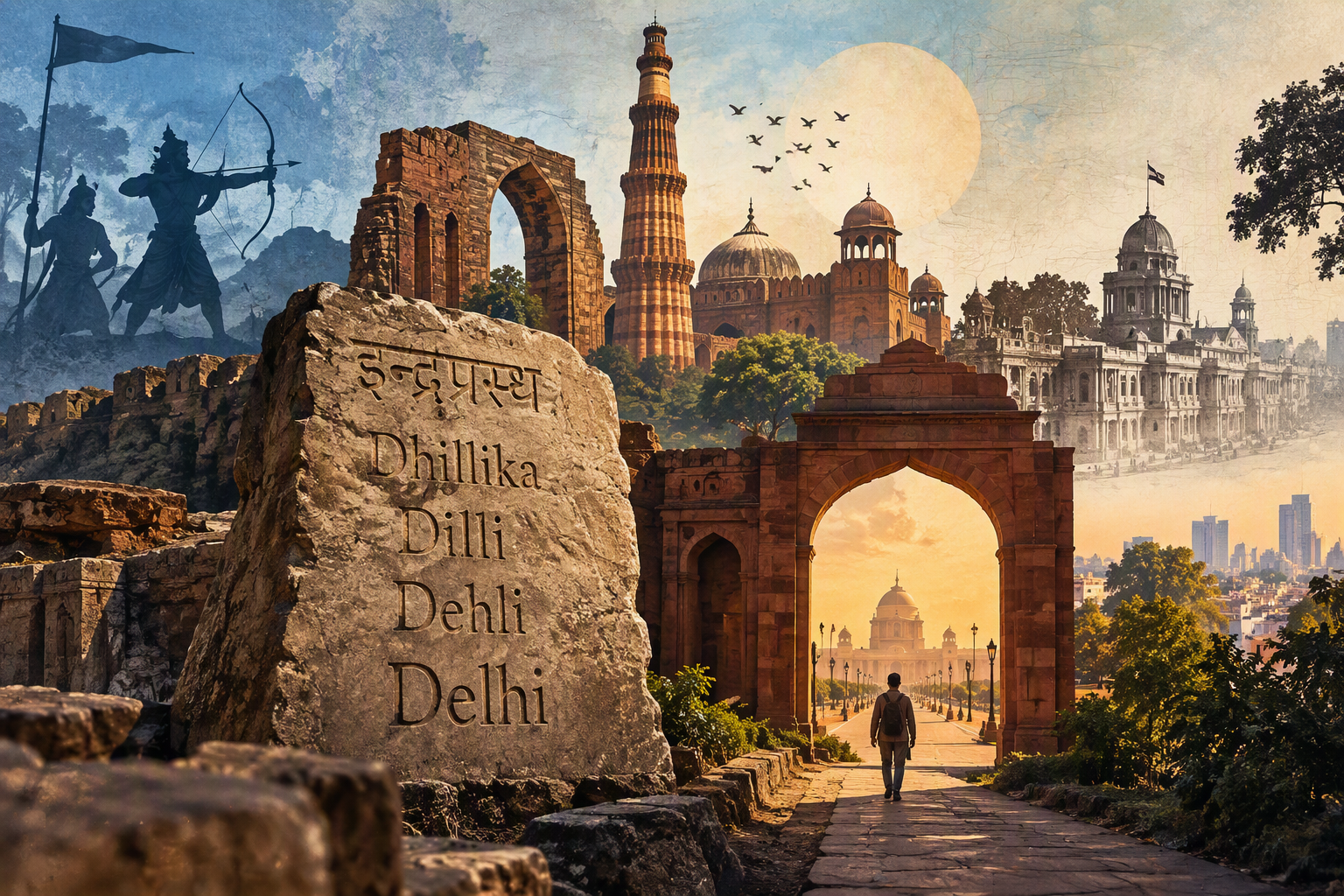
Cities carry memories, but some cities seem to carry time itself. Delhi is one such city. Empires have risen and vanished here, dynasties have renamed neighbourhoods and rebuilt capitals, conquerors and colonisers have sought to imprint their authority on its landscape, yet the city has continued to answer to a name that appears older and more enduring than many of its rulers. Why has Delhi remained Delhi when so many other Indian cities have reclaimed, revised or reinvented their names? In The Shortest History of Delhi, historian John Zubrzycki approaches the city not merely as a political capital but as a living archive of myths, invasions, faiths, ambitions and memories. Through a brisk yet evocative narrative, he traces how Delhi became an idea larger than geography: a city repeatedly destroyed and recreated, yet never deprived of its identity. Sudhirendar Sharma reflects on a book that explores the many histories embedded in a single name and asks what makes Delhi one of the world's most enduring urban imaginations.
The Shortest History of Delhi : Book Review
What’s in a name?
Sudhirendar Sharma
Known originally as Indraprastha, which is mythically attributed to the Pandava kingdom, the origins of the name Delhi remain uncertain, though several theories trace it to early historical and medieval references to Dilli, Dhilli or Dhillika. There is no clarity on how the city got this name, and why has it persisted for so long? More so when several Indian cities have officially changed their colonial-era names, from Calcutta to Kolkata and Bombay to Mumbai, while Delhi has remained Delhi.
What’s in a name? Shakespeare's famous observation that "a rose by any other name would smell as sweet" may not hold true for cities, whose names often embody history, memory and identity. The city gives the place its identity, a reason for it to carry it. The city carries many reasons for its being. Some interpret the city’s name to mean threshold (dehleez or dehali), reflecting as an entry point into India. John Zubrzycki, an Australian author with a Ph.D in Indian history from the University in New South Wales, adds fascinating complexity to the city’s multi-layered history.
The story of city’s name has an interesting history. During the reign of the Tomar king Anangpal (in the eleventh century), Hindu bards variously called it dilli, dhilli or dhillika. The British heard the Hindus pronouncing it as dilli while the Muslims were comfortable calling it dehli. Such distinctions may have acquired political overtones over time. It seems good sense prevailed in putting such mindless controversy to rest, the correct spelling of the official name being ‘Delhi’. Resilience is central to Delhi's character.
Many parts of the city have been renamed, but the city has got its distinct identity intact. ‘Delhi is still a name to conjure with,’ wrote Lord Hardinge, when arguing against the shifting of the capital ‘It is intimately associated in the minds…which go back even beyond the dawn of history.’ Lord Crewe, then the secretary of state, declared that the creation of a new capital would be taken as ‘an unfaltering determination to maintain the colonial rule’. It was for the colonialist to justify shifting the capital from Calcutta to Delhi. Never, however, the case for changing the name of the city ever featured.
Delhi not only retained its mythical status, but much beyond it. Through its stories of intrigue and empire, Zubrzycki chronicles more than a thousand years of Delhi's history through invasions and the struggles. There is an interesting inscription, that dates back to 1607, which highlights the imperial significance of Delhi. It refers to Akbar as Dillishvara, the lord of Delhi, although Akbar spent relatively little time ruling from Delhi itself.
A Persian inscription, dated to 1621, described Jahangir as Shahanshah-e-Delhi on the Salimgarh bridge. Interestingly, Jahangir hardly lived in Delhi. Not only imperial kings, its many shrines, tombs and resting places of saints earned it the moniker "The Threshold of Twenty-Two Saints". There are interesting sub-stories within the main story of Delhi. The nomenclature that make up Delhi make it for many cities, and lay within them the endless games of discovery.
It is hard not to romanticize Delhi. Its story is one of empires and intrigue, splendour and decay, destruction and rebirth. Over centuries, one city has grown upon the remains and memories of another, leaving history visible almost everywhere. Many books have tried to understand Delhi through different lenses, but the challenge is to tell its story without losing what makes the city so singular. Delhi can intimidate and inspire, exhaust and exhilarate in equal measure. It is ancient and restless, bruised and resilient. It’s a city called Delhi.
Today, Delhi is a sprawling metropolis that draws people from every corner of the subcontinent, a mosaic of religions, languages, castes, classes and aspirations. Yet beneath this diversity lies a remarkable continuity. Through centuries of upheaval and reinvention, one thing has endured: the name Delhi. As Zubrzycki's book persuasively demonstrates, that name is not merely a label. It is the repository of a thousand years of memory, power, myth and resilience.
The Shortest History of Delhi
by John Zubrzycki
Picador India
Extent: 214. Price: Rs.433

Sudhirendar Sharma is a writer, researcher and academic.

We are trying to create a platform where our readers will find a place to have their say on the subjects ranging from socio-political to culture and society. We do have our own views on politics and society but we expect friends from all shades-from moderate left to moderate right-to join the conversation. However, our only expectation would be that our contributors should have an abiding faith in the Constitution and in its basic tenets like freedom of speech, secularism and equality. We hope that this platform will continue to evolve and will help us understand the challenges of our fast changing times better and our role in these times.
About us | Privacy Policy | Legal Disclaimer | Contact us | Advertise with us


