
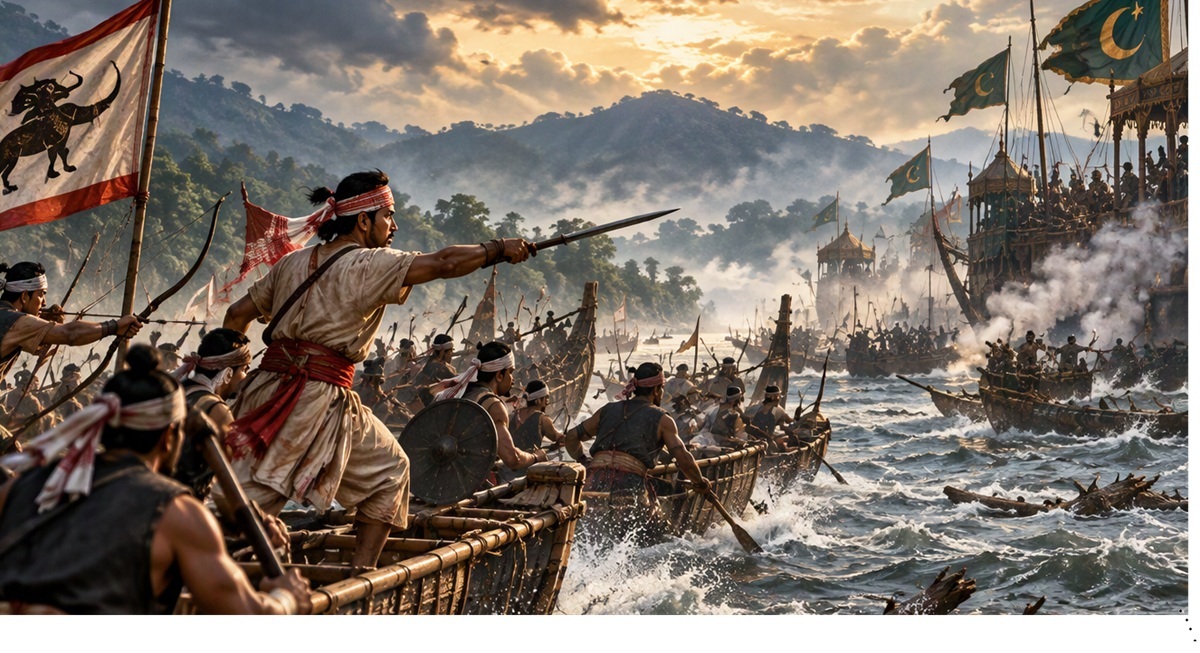
The Epic Story of the Ahom comeback
Sudhirendar Sharma
Over four hundred years, there were seventeen invasion attempts by powerful kingdoms and empires, including the Nawabs of Bengal, the Delhi Sultanate, and the mighty Mughals, to bring the rich lands of the far east into their domains. Yet each attempt was foiled by the native Ahoms. The historic final Battle of Saraighat (1671 CE), fought between the Mughals under Aurangzeb and the Assamese forces under the leadership of the Ahom general Lachit Borphukan, is iconic in many ways. However, deploying the capable general Mir Jumla was not entirely comfortable for Aurangzeb. One of the wealthiest men in the empire, second only to the Emperor, Jumla’s ambition to expand Mughal influence in the east had often unsettled him. A man with such wealth, influence, and ambition could easily become a threat to the throne.
Knowing well that the Ahoms had never been defeated in the past, Jumla asked the Mughal forces led by Allah Yar Khan:
“Why have the Ahoms not been defeated so far?”
“The river.”
The natives did owe much of their invincibility to the river. “The Brahmaputra is the only way anyone from the west can enter Assam.” On top of that, the Ahom soldier was brave and highly skilled in hand-to-hand combat. Jumla recommended a well-thought-out strategy to deal with the seemingly invincible Ahoms, one that he believed would bring the Mughal Empire to new heights. Yet, the more he thought about the war, the more convinced he became that the Emperor perceived him as a threat. At sixty-nine, it was hardly prudent for Aurangzeb to create a new enemy.
Spread across three sections, this is an absorbing book on the sociology and politics of The Sixteenth Invasion. Insightful yet provocative, it raises an important question: how was victory snatched from the jaws of defeat at Saraighat? Simply put, the Mughals had come prepared to fight an artillery battle, but the Ahoms turned it into infantry combat on ships. They wrestled, strangled, punched, and bit their enemies. In the process, the Mughals were thoroughly outsmarted by the Ahoms.
The mighty Brahmaputra added to their plight. The majestic river was often in spate. Uprooted trees, random debris, and stinking carcasses were a common sight, as if the river itself was determined to keep invaders out of Assam. No Mughal soldier ever dared to take a boat into the swollen waters. Once the rains began, military operations were often suspended for months, sometimes even for a year. The majestic river, forested lowlands, and marshlands emerged as key allies of the Ahoms against the Mughals.
The Sixteenth Invasion is a debut attempt that weaves together threads of treachery, betrayal, conspiracy, and defeat. The story begins in what is today part of Yunnan, when Prince Sukapha from the Shan kingdom reached the Brahmaputra valley in 1228 CE. It took him more than three decades to establish the Ahom kingdom. Over the next two hundred years, Sukapha’s successors extended Ahom influence across the north-east. The Ahoms were ruthless when necessary but industrious in consolidating and extending their rule.
The Ahom story is incomplete without the Mughals. Had the war of succession been long over, Aurangzeb might have dealt with the region differently. But with Dara Shukoh dead, Murad imprisoned, and Shah Shuja in exile in Burma, what options did Aurangzeb truly have? With the history of fifteen failed invasions on their side, the Ahoms were far ahead in both attitude and approach. Vijay Gogoi brings alive the near-legendary events of the seventeenth century that remain an indelible part of Assam’s history.
The Sixteenth Invasion is a retelling of the major attempts by the Mughals to conquer the Ahom kingdom, efforts that the natives resisted tooth and nail. This is more than the story of a war. The defeat at Saraighat forced the Mughals out of Assam. They had committed substantial military resources to the campaign, only to abandon the idea of using overwhelming force against the Ahoms thereafter. It is also the story of the mighty Brahmaputra and the unforgiving terrain. While breathing life into his characters, Gogoi brings the ecosystem vividly to the page. When large empires routinely devoured smaller kingdoms, the Ahoms stood their ground for nearly six centuries.
Sudhirendar Sharma is a writer, researcher and academic.
by Vijay Gogoi
Penguin Eight, New Delhi
Extent: 324 pages; Price: Rs. 699.
**********

Sudhirendar Sharma is an independent writer, researcher and academic.

We are trying to create a platform where our readers will find a place to have their say on the subjects ranging from socio-political to culture and society. We do have our own views on politics and society but we expect friends from all shades-from moderate left to moderate right-to join the conversation. However, our only expectation would be that our contributors should have an abiding faith in the Constitution and in its basic tenets like freedom of speech, secularism and equality. We hope that this platform will continue to evolve and will help us understand the challenges of our fast changing times better and our role in these times.
About us | Privacy Policy | Legal Disclaimer | Contact us | Advertise with us


