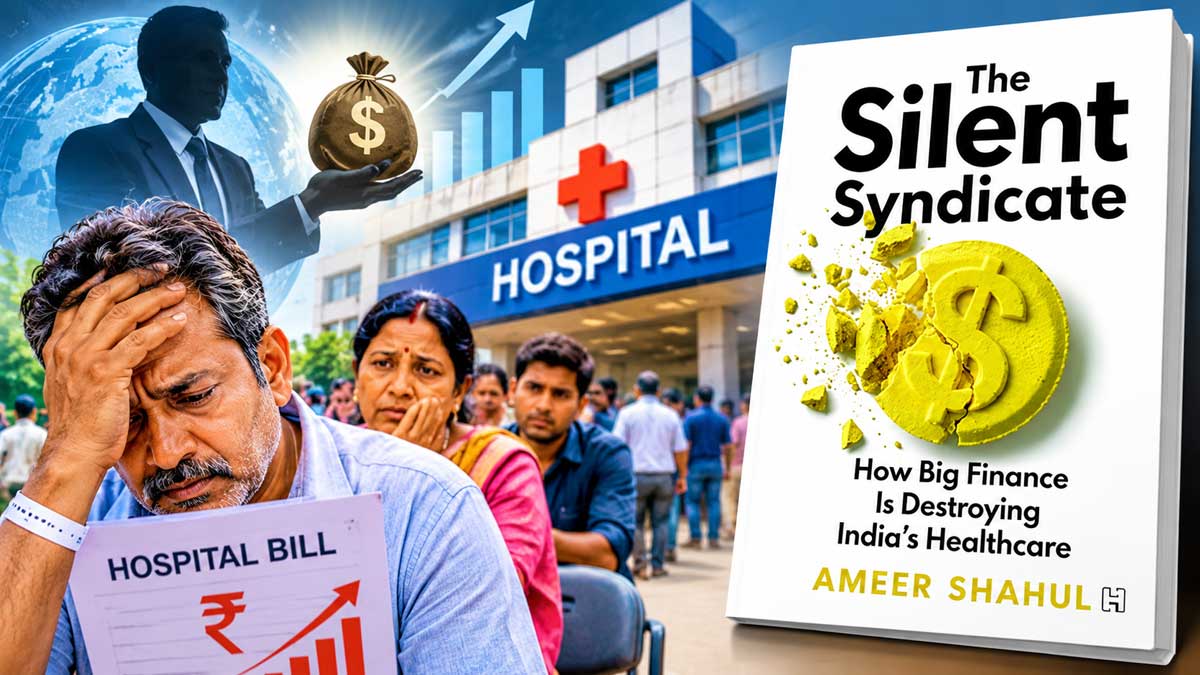
Health Care: Silence Is Not the Answer
Sudhirendar Sharma
Ameer Shahul has emerged as an incisive writer who unearths narratives with investigative depth. As a public policy analyst, his well-acclaimed two books (Vaccine Nation: How Immunization Shaped India and Heavy Metal: How a Global Corporation Poisoned Kodaikanal) have drawn attention to gross negligence and sheer exploitation within the healthcare sector. The result is an absorbing and meticulously researched treatise on how private finance is transforming the country's vast healthcare sector, from pharmaceuticals to diagnostics and from hospitals to health insurance. As a consequence, the patient has been turned into a consumer who can ill afford the cost of treatment.
 Across the country, families face the nightmare of treatment in hospitals. For the average citizen, hospital care has never been more expensive. Everyone has a story to tell, from the unbearable cost of getting admitted to paying through the nose for treatment. The cumulative impact is that over 55 million people are pushed below the poverty line each year due to unforeseen medical expenditure. Given the demand-supply gap in healthcare, global private equity has flowed in to keep the sector growing and expanding.
It is no surprise that foreign private equity capital has turned private hospitals into branded chains. Apollo, Fortis and Max have carved a name for themselves in the process, and diagnostic chains such as Dr Lal PathLabs and MedPlus are not far behind. Many upcoming brands are also entering the fray. As a result, not only has privatisation increased the cost of healthcare, but foreign investors have gained control over significant parts of the healthcare system without directly owning them. The entire system has been compromised, with the lexicon of care rewritten: a hospital is now a service provider offering a package of health services. It is no surprise, therefore, that poor and middle-class families often sell land or borrow heavily to pay hospital bills.
Ameer laments that the healthcare system increasingly perceives the patient as a cash cow to be milked right at the hospital gate. To make the system deliver, super-specialty hospitals often give their doctors monthly or annual targets for conducting medical procedures. Such targets extend to other disciplines of medicine as well, with ever-eager doctors ready to bring unsuspecting patients under the scissors and scalpel. There are numerous instances of doctors feeling pressured by revenue targets. The Silent Syndicate is painfully packed with such cases from across the healthcare domain.
It is no accident that things are the way they are. The health sector is increasingly driven by global private equity investment that prioritises investors and their return on investment. As non-communicable diseases such as cardiac ailments, diabetes and cancer require prolonged care, private equity has found an attractive investment opportunity even in smaller cities and towns. It exerts control over how hospitals operate and expand, while the cost to the patient is shaped by hospital targets and profit expectations.
The book uncovers the growing interest of global finance in the healthcare sector and examines the long-term gains it seeks. A careful study of foreign capital flows into hospitals clearly indicates that the patient is no longer at the centre of the healthcare ecosystem; capital flows and the profits they generate are. "When a nation allows the language of profit to replace the language of care, it suffers not merely the loss of its sovereignty but of its conscience too." What else could be expected when healthcare priorities are guided by private equity firms and drug prices are determined by Big Pharma?
Sickness has become so profitable that it is no surprise that every corporate house is entering the healthcare business. The Silent Syndicate exposes the nexus between hospitals, which function like financial institutions, and doctors, who increasingly act like service providers. The silence in the policy arena is palpable. With the government playing subservient to private players, the health sector is effectively under siege. The more people fall sick, the more the healthcare system stands to gain. As the book observes, "If everybody were to remain healthy, then the doctor will report himself sick."
The question is how to get out of this trap. Without a fundamental shift in how health is perceived, there can be little escape from the treadmill of sickness. Ameer outlines a broader framework for change. First, the sector must reclaim healthcare from the logic of profit; second, the regulatory framework needs strengthening. Investments, whether domestic or foreign, must be tied to public health goals, ensuring both outreach and affordability.
There is an urgent need to rethink how we manage sickness, for the sake of our economy, our well-being and our health services.
The Silent Syndicate makes a timely and compelling case for doing exactly that.
Book: The Silent Syndicate
Author: Ameer Shahul
Publisher: Hachette, New Delhi
Extent: 312 pages
Price: ₹799

Sudhirendar Sharma is an environmental journalist and a development professional. He also writes music notes for this website.

We are trying to create a platform where our readers will find a place to have their say on the subjects ranging from socio-political to culture and society. We do have our own views on politics and society but we expect friends from all shades-from moderate left to moderate right-to join the conversation. However, our only expectation would be that our contributors should have an abiding faith in the Constitution and in its basic tenets like freedom of speech, secularism and equality. We hope that this platform will continue to evolve and will help us understand the challenges of our fast changing times better and our role in these times.
About us | Privacy Policy | Legal Disclaimer | Contact us | Advertise with us