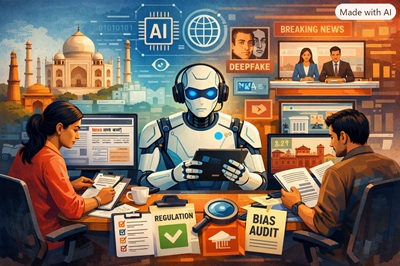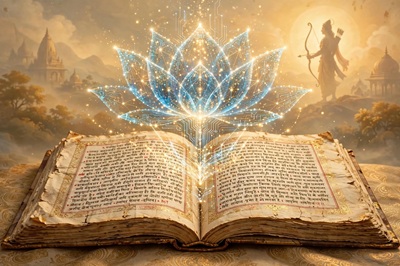
You may have read several essays on artificial intelligence in Raag Delhi, exploring its technologies, promises, and challenges. This article by Dr. Shailesh Shukla, however, approaches AI from a strikingly different perspective. Drawing on the ethical wisdom of Ramcharitmanas, he asks not how intelligent machines can become, but how human values such as maryada, compassion, accountability, and vivek can guide their development in an increasingly AI-driven world. His essays in Hindi on this website can be seen by clicking on his name डॉ. शैलेश शुक्ला.
Ethics for AI in Ramcharitmanas
Dr. Shailesh Shukla
I grew up listening to Ramcharitmanas before I understood it.
In our house, in our village, winter evenings belonged to that one lamp, and my grandfather would read the Manas in a low voice. I did not know the meaning of every chaupai then. I just knew that when Ram spoke, there was calm. When Ravan spoke, there was noise, even if he was right.
Years later, when I started reading about artificial intelligence, that same feeling came back.
We now have a new intelligence among us. It can write, paint, and even influence who gets a job or a loan. It knows everything. The question is not what it can do.
The question is what it should do. While Tulsidas was writing in a very different age, some of the ethical principles he emphasised remain surprisingly relevant. He never calls Ram the most powerful. He calls him Maryada Purushottam. The best man is not the one who can do everything. He is the one who knows where to stop.
This is the first and foremost element of ethics for AI.
Ravan knew the four Vedas. He had a kingdom of gold, flying machines, knowledge that no one else had. He fell because he had no maryada. He crossed lines that should not be crossed.
An AI without maryada is the same. It may be brilliant, but it will be dangerous. It needs a Lakshman Rekha. It must know it cannot enter someone's private life, cannot make a fake video of someone's daughter, cannot decide to humiliate a community just because it can.
Then there is a chaupai every child in our villages knows:
"Parhit saris dharma nahi bhai, par peeda sam nahi adhamai."
There is no dharma bigger than helping others. There is no sin bigger than hurting others.
We keep saying AI should be efficient. Manas says something different. It says, does your work reduce someone's pain? That is the test.
If an AI can write perfect English but cannot understand a farmer asking for help in Awadhi or Bhojpuri, is it really intelligent? In Manas, Ram eats the berries of Shabari, already tasted by a tribal woman. He hugs Nishad, the boatman, like a brother. He makes an army out of Vanaras, out of those whom the world called jungle dwellers. That is samta. That is fairness.
Our models today fail here. They think light skin is beautiful, English is knowledge, a certain accent is more trustworthy. Similar concerns have led policymakers and regulators to increasingly emphasise checks against bias related to caste, gender, language, region, and other social factors. Tulsidas had done that bias check five hundred years ago in his own way.
The third lesson is hard. It is about who is responsible.
"Jasu raj priya praja dukhari, so nrip avasi narak adhikari."
The king whose people are unhappy in his rule will certainly face hell.
Today AI is like a king. It decides. So who is accountable when it goes wrong? You cannot say, the algorithm did it. In Manas, Ram does not sit inside the palace. The tradition remembers Ram as a ruler who took public opinion seriously, even when doing so caused him deep personal suffering as in the case of Sita's Agni Pariksha. That is accountability.
If a facial recognition system fails to recognise women who wear a burqa, if an AI hiring tool rejects a Dalit boy because of his surname, the maker cannot hide. He has to come forward. That is what the Supreme Court has also underlined it that we need transparency in AI surveillance.
And finally, the difference between information and vivek.
Ravan had information. Bharat had vivek. When Bharat was offered the throne of Ayodhya, he refused. He said, this is not right. That is vivek.
AI has information of the entire internet. It does not have vivek unless we give it. In Manas, vivek comes from three things. Satsang, sanyam, and karuna - Good company, self-control, and compassion.
For AI, satsang means good data. Data that has our folk songs, our kathas, our diverse ways of living, not just abuse and hate from social media. Sanyam means it should be able to say no. No, I will not make a deepfake. No, I will not write a hate speech in Maithili. Karuna means it should not replace the ASHA worker in a village, but help her speak better to a new mother in her own language.
At the end, Tulsidas describes Ram Rajya not as a rich kingdom, but as a kind one.
"Sab nar karahin paraspar preeti, chalahin swadharma nirata shruti neeti"
Everyone loves each other. Everyone follows their own duty with discipline and knowledge.
That is the only test I would keep for AI in India. Not how smart it is. But does it make us love each other a little more? Does it make us understand each other's languages a little more? If it does, people will embrace it with trust rather than fear.
If it just makes a golden Lanka full of power without maryada, we will know what to do. We have known the answer for centuries.
*************

Dr. Shailesh Shukla has been actively engaged for two-and-a-half decades in research on Digital Media, AI, Academics, Official Language, Administration and Language Governance & Policy Implementation. After a decade of journalism and teaching in Delhi, serving as the first Rajbhasha Officer of Sikkim University and as Official Language Officer in a Central PSU, he is presently Global Group Editor at Srijan Sansar International Group of Journals and Consulting Editor at The GaurSons Times. He is Principal Consultant at New Media Srijan Sansar Global Foundation and Adamya Global Foundation. He taught at Delhi University and Sikkim Central University. With Ph.D. on 'Hindi Literature in New Media', he has written 40+ chapters including for DU and IGNOU courses, authored/edited 25+ books, and 1000+ writings including 40+ Research Papers, Articles, Poems, Stories, Satires in 200+ media outlets of India and abroad. Recipient of Rajbhasha Gaurav Puraskar 2019-20 by MHA, Govt. of India, Navodit Lekhak Puraskar 2003-04 by Hindi Academy, Govt. of NCT Delhi, ERAI Fellowship by Knowledge Network, Virginia, USA, and many other honours.

We are trying to create a platform where our readers will find a place to have their say on the subjects ranging from socio-political to culture and society. We do have our own views on politics and society but we expect friends from all shades-from moderate left to moderate right-to join the conversation. However, our only expectation would be that our contributors should have an abiding faith in the Constitution and in its basic tenets like freedom of speech, secularism and equality. We hope that this platform will continue to evolve and will help us understand the challenges of our fast changing times better and our role in these times.
About us | Privacy Policy | Legal Disclaimer | Contact us | Advertise with us