Early this week, when we approached Amandeep Midha for a piece on the situation in Europe, he said it was in total mess and that new developments were unfolding almost by the hour. Things were moving too fast to be captured adequately. However, he subsequently sent this article, which is a conglomeration of comments on the situation in different parts of Europe.
It is certainly an unusual kind of article, but also a kind of utility item, functioning almost as an explainer on contemporary Europe. And, quite intriguingly, Amandeep has not commented on the situation in the United Kingdom. We could have asked him privately, but instead chose to do so publicly in the hope that his reply might itself become another article. After all, recent reports have highlighted advice from the UK government urging citizens to keep essential supplies sufficient for at least three days in the event of major disruptions to daily life, a reminder that anxieties are hardly confined to continental Europe.
In the meanwhile, just to update the picture, it may be worth adding that recent cyberattacks on connected refrigeration systems have disrupted supermarkets across several European countries, causing deep freezers and cold-storage units to malfunction and resulting in significant food spoilage and financial losses.
Now, over to Amandeep for a glimpse of the continent's remaining troubles.
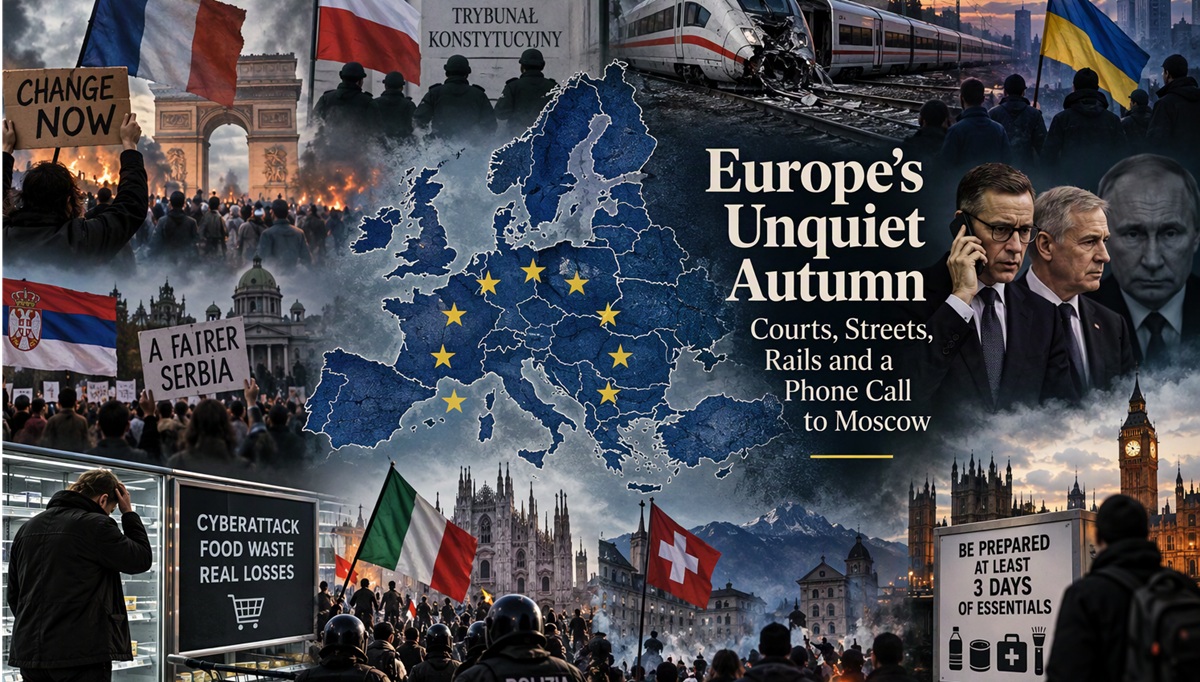
Europe's Unquiet Autumn: Courts, Streets, Rails and a Phone Call to Moscow
Amandeep Midha
The last week of October 2026 handed Europe a cluster of headlines that, read together, say more than any one of them alone: institutions under strain, publics losing patience, and allies disagreeing about how to deal with Russia. Several stories are still moving, so where facts are contested, I say so.
Poland: A Fight over who guards the constitution
Poland has two rival power centres. President Karol Nawrocki is a conservative aligned with the PiS opposition; Prime Minister Donald Tusk leads a pro-EU centrist government. Their quarrel reached the Constitutional Tribunal this week. Police appeared at the court while Nawrocki was flying to Senegal, and he turned his plane around. Nawrocki, sitting tribunal members and PiS leader Jarosław Kaczyński call it a coup. Tusk says he is restoring the rule of law and notes that Russia's Dmitry Medvedev has echoed the "coup" charge, which he treats as proof of pro-Russian sympathies among his critics.
Note the direction of the accusation: it is the conservative president's camp alleging a coup by the prime minister, not the reverse. Similar claims surfaced in 2025, when reports said Tusk's circle had sought to delay Nawrocki's swearing-in. Those allegations remain contested.
Serbia: The Media Reckoning
Serbia's snap election ended Aleksandar Vučić's long dominance. The student-led Student List won 140 of 250 seats in provisional results, against 104 for Vučić's Progressive Party, and he conceded. Within days, Radio Television of Vojvodina, a provincial public broadcaster, apologised to viewers for years of one-sided, uncritical reporting, and the head of national broadcaster RTS resigned. Protesters also entered the newsroom of a pro-Vučić channel.
The Nordic split over Putin
On 27 October, Finland's President Alexander Stubb and Norway's Prime Minister Jonas Gahr Støre held a 90-minute call with Vladimir Putin, then briefed Volodymyr Zelensky. Their aim was to nudge US-brokered talks toward a ceasefire at a time when Washington's stance has tilted toward Moscow. Denmark's Mette Frederiksen accused them of "going solo" and said the call was not coordinated; Sweden's Ulf Kristersson said some leaders were not informed. Støre insists allies were told in advance and that he and Stubb spoke only for their own countries. The lasting damage is to Nordic unity: a region that prides itself on consensus has found that its members define "coordination" differently.
Ukraine aid and the missing millions
Danish investigative outlet Danwatch reported on 30 October that 71 million kroner meant for artillery shells for Ukraine ended up with an Italian software firm, later bought by Indian companies, none of which has ever manufactured shells. No shells reached Ukraine, and the parties have reportedly refused to return the money. The funds were part of a 300-million-kroner package channelled through Estonia, whose defence minister resigned over the affair in September.
This is a serious scandal, but "rampant corruption" overstates what is documented so far. It is one traced case, in one package, via a third country. Denmark's own "Danish Model" of paying Ukrainian manufacturers directly was designed with audits to limit exactly this risk, which is why intermediary arrangements deserve the sharpest scrutiny. Indian readers should note that Indian-owned entities appear in the story; their role has not been established, and the companies' side deserves a hearing.
France: from Classrooms to a National Crisis
France's unrest began in September over school conditions and teacher shortages in working-class suburbs, then widened into a movement against inequality, cost of living and public-spending cuts. On 17 October protests turned into riots: one demonstrator died, hundreds of police were injured, nearly 1,800 people were arrested, and a town hall was torched. Yellow-vest activists and trade unions joined, and unions have called strikes for 5 November. The trigger is a proposed 43-billion-euro cuts package in the 2027 budget, which the minority government of Prime Minister Sébastien Lecornu struggles to pass.
The interpretations are predictably political. Lecornu blames the "ultra-left" and criminals; Donald Trump blames mass migration. The evidence points to a fiscal and social contract under stress, with a presidential election due next year.
Italy: the French contagion
Italy's unrest began on 17 October, the same weekend as France's worst riots. Protests over the cost of living and weak public services turned violent in Milan, Turin, Bologna, Brescia and Bergamo, with looting in Milan, and police used tear gas and water cannon. Many of those involved were minors. A second wave on 24 October, now also against war and arms spending, met heavy security: army paratroopers patrolled Milan, and police made nine arrests and briefly detained 371 people, 110 of them minors. They also arrested a 30-year-old suspected of running the online "October 17 Movement". Prime Minister Giorgia Meloni condemned the violence and praised the security operation, while critics point to inequality. The CGIL union has called a general strike for 20 November, which could be very significant in the post-US midterms world.
Switzerland: A Rare Flare-up
Even Switzerland saw trouble that same weekend, though on a far smaller scale. Late on 17 October, an unauthorised "spontaneous" march formed in Bern. Masked participants set off fireworks and, according to Bern police, attacked officers with pyrotechnics and projectiles, and police responded with rubber pellets and rubber bullets. The first police report listed no injuries and an investigation was opened. The statement did not say what the protest was about, and there is no evidence yet that it was part of the French and Italian movements. It does follow Bern's violent pro-Palestinian demonstration of October 2025, after which Swiss lawmakers have moved to double the time suspects can be held in custody. Swiss protest tends to be less radical than in France or Italy, which is why such scenes still make news.
Spain: a Second Rail Disaster
On 28 October, two high-speed trains collided near Urda in Castilla-La Mancha, killing more than 60 people. Transport Minister Óscar Puente said a computer communications malfunction and human error were involved: one train was wrongly authorised to continue despite a red signal and travelled about 25 kilometres before hitting a stationary one. The investigation is ongoing, and that is the official preliminary account, not a final finding. It follows January's Adamuz crash, which killed 46 and was linked in preliminary findings to a fractured rail. Experts caution that these may be different failures, in track maintenance and in signalling respectively.
What connects them
These stories share a pattern: leaders and institutions are being judged by publics that no longer extend credit. For India, which is deepening ties with Europe, the lesson is that the continent is becoming politically noisier, less predictable and perhaps more interesting than its longstanding reputation for stability suggests.
************

Amandeep Midha is a technologist, writer, and global speaker with over two decades of experience in digital platforms building, data streaming, and digital transformation. He has contributed thought leadership to Forbes, World Economic Forum, Horasis, and CSR Times, and actively engages in technology policy-making discussions. Based in Copenhagen, Amandeep blends deep technical expertise with a passion for social impact and storytelling.

We are trying to create a platform where our readers will find a place to have their say on the subjects ranging from socio-political to culture and society. We do have our own views on politics and society but we expect friends from all shades-from moderate left to moderate right-to join the conversation. However, our only expectation would be that our contributors should have an abiding faith in the Constitution and in its basic tenets like freedom of speech, secularism and equality. We hope that this platform will continue to evolve and will help us understand the challenges of our fast changing times better and our role in these times.
About us | Privacy Policy | Legal Disclaimer | Contact us | Advertise with us