
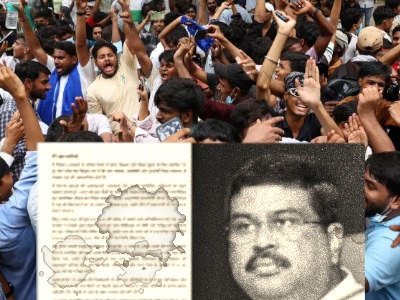
In this strong, uncompromising piece, Manoj Pandey, a former member of the Staff Selection Commission, (SSC) asserts that the resignation of a minister is symbolic, but the rot in the examination system runs much deeper. He argues that resignation will not help reform in the system as the mafia of exam malpractices remains untouched. Paper leaks are just the visible tip; impersonation, coaching‑driven “guess questions,” manipulation of invigilators, and even tampering with medical fitness tests are listed as termites hollowing the system. He insists on a “zero‑error mindset” in agencies like UPSC, SSC, NTA, and state PSCs. He calls for expert‑driven, politically insulated reforms, fast‑track courts, and cleansing of school boards where malpractice culture begins.
The Education Minister has resigned, so what?
Manoj Pandey
I am posing this question apolitically, so be ready to get my own answer that might look politically incrorrect.
A Minister’s resignation does not change the ground realities. The mafia that works in the field of examination-related malpractices is there, preparing for the next competitive examination- be it a state-level examination or an all-India examination. People who are ready to pay big sums to get their wards into prestigious institutions of higher learning or public offices are not going to change their mind after today. Officials who either work clandestinely to make money by exploiting executional and procedural loopholes in the examination system are not going to feel too afraid of action against them.
In India, the cost-benefit analysis of examination-related manipulations is highly skewed towards reward. Criminals know fully well how they can manipulate the legal system to evade even the toughest laws of the land. On the other hand, candidates and their wards have nothing to lose, because most of them who use these methods are the ones who have little chance of getting into the system by using fair means.
So, a Minister’s resignation helps little (apolitically speaking!). If we do not overhaul the system, the next examination will have another major paper-leak event, however hard the minister tries to stick to his seat. For that matter, most of the discussion in Parliament will also not produce much. Parliamentary debates will definitely release the gas in the form of flowery points and counter-points. Yes, it will perhaps lead to passing of a strong law but, as I submitted earlier, a strong law is hardly a big deterrent.
That begs the question- then what?
The answer lies in running the machinery with a zero-error mindset. It is not that the examination-conducting bodies, such as the UPSC, SSC, Railway Recruitment Board, BSRB, NTA, state PSCs, and other central or state-level recruiting agencies, do not take care of detailed planning, execution, monitoring, and other aspects. Without that, they would not be able to conduct examinations with many lakh candidates sitting in the exams across thousands of centres. In fact, paper-leaks such as the NEET paper-leak that is in the highlight at present come to public notice just once out of hundreds of examinations. A successful paper-leak either escapes the attention of the recruiting agency or gets suppressed. It gets out of hand very rarely.
The more unpalatable fact is that paper-leaks are a tip of the iceberg. There are many other forms of examination-related malpractices that are equally serious, if not worse. In fact, it is these unseen forms that eat the vitals of the examination system like termite, resulting in undeserving candidates finding seats in prestigious institutions and government offices. Such candidates are a burden on the system in many ways- they try to recover the cost of their illegal actions, they propagate the malpractices among peers and family, and they believe in extracting their cut while providing public services. For those not fully versed with the examination system, let me enumerate some of these malpractices- impersonation and cheating in examination centres, ‘guess questions’ suggested by coaching institutes, getting examination centre/ room/ invigilator of one’s choice, manipulating examiners, manipulation of health markers in medical tests (especially for police forces), and so on.
Though modern technology has made it easier to control some of these malpractices, it does not guarantee a full solution. While it is also possible to manipulate technology using modern electronic/ IT/ AI tools, the bigger issue is complacency (no zero-error mindset) on the part of the recruiting agency.
In the present NEET case, reports are that a large number of officers of the recruiting agency, NTA, have been shunted out and the agency is being overhauled in a big way. Hope this and other reformative actions are taken with all seriousness, not only in the NTA but all other recruiting agencies.
Allow me to end in a bit of political comment: Let politics be out of examination reforms (after the present political drama is played out). We have seen that in the past, the Public Service Commissions in some states were filled with the favourites of the ruling government. Let experts evolve systems that are fool-proof; let them work independently of political pressure; let governments provide them full administrative support, including provision of fast-track courts.
There is also a need to clean the examination system of examination boards at the central and state levels. Of course, the solutions to their issues are different, but it is the school examination system that give the first learning and taste of malpractices to the students and their parents.
*********

Manoj Pandey is a former Member the Staff Selection Commission. He has contributed extensively to this web magazine, particularly in the विज्ञान (Vigyan) and स्वास्थ्य (Swasthaya) categories. he also makes Videos in Hindi showcasing his commitment to informing the common-man on these important issues. His videos can be seen on YouTube under the heading 'Hindi Health Videos' .

We are trying to create a platform where our readers will find a place to have their say on the subjects ranging from socio-political to culture and society. We do have our own views on politics and society but we expect friends from all shades-from moderate left to moderate right-to join the conversation. However, our only expectation would be that our contributors should have an abiding faith in the Constitution and in its basic tenets like freedom of speech, secularism and equality. We hope that this platform will continue to evolve and will help us understand the challenges of our fast changing times better and our role in these times.
About us | Privacy Policy | Legal Disclaimer | Contact us | Advertise with us

