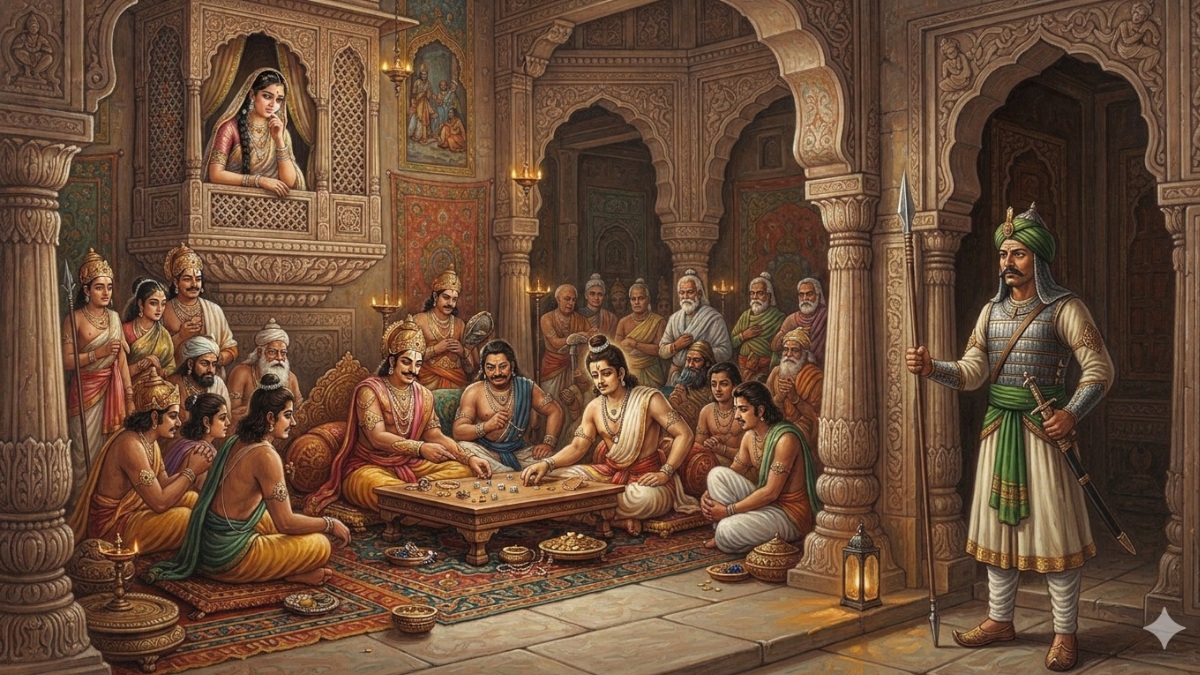
The grand events of the Mahabharata are often remembered through the deeds of kings, warriors and sages. Yet every turning point in history is also witnessed by countless ordinary people whose names are forgotten. This narrative, presented by Dr Sandeep Bhatnagar, revisits the fateful dice game of Hastinapura through the eyes of one such anonymous guard stationed at the door of the Hastinapur palace. As the guard witnesses the humiliation (of Draupadi) and silence of elders unfold before him, he is compelled to confront a question that echoes throughout the epic itself: when injustice occurs, is neutrality ever truly possible?
The Guard at the Door: Revisiting the Mahabharata
Dr Sandeep Bhatnagar
An unnamed guard stands at the door of the great assembly hall of Hastinapura. Inside, the game of dice is being played.
I stand at the threshold, spear upright, as I have stood for eleven years. My name is not worth the breath it would take to utter it. The chroniclers will not inscribe it. The poets who will sing of this day for a thousand generations will sing of kings, of a queen, of a blind monarch and his righteous nephews and ravenous sons. They will not sing of the man who held the door. And yet I saw it. All of it. As I held the door.
Inside, the dice are falling. I hear them more than I see them; that dry, skeletal clatter on the board, like coins rattling in a mendicant's bowl. On every throw, someone smiles, and something vanishes. Is this the way of life? A few dice deciding the fate of kingdoms. A treasury. A stable of horses. A city. The things which we can't even think of are traded like trinkets. Are men and wealth to be squandered this way? I have seen gamblers in the bazaar lose a cow, a cart, a season's grain, and I thought that was ruin. I did not know ruin could wear silk and recline upon a throne. I am aghast as I stand by the door.
What is it, this insatiable hunger? Hunger for wealth, power and authority. I have watched people of either side walk past me a hundred times, stoic and sober, rough and violent, a water unruffled and seething. With every throw of dice, someone loses; someone gains, yet both choose to play on. That is the strangest thing. Desire does not abate with defeat; it is nourished by it. It is a fire that devours the very hand that tends it, and for some reason, the hand keeps feeding it. I am nobody to philosophise as I stand by the door.
Was it that someone got hurt by the giggles of a lady, or someone was seeking a right to a portion of the land? One laugh. One request. Can an empire be wagered to avenge one laugh or reject a demand? Apparently it has been done, and the lives of people are being decided sitting across a board. Envy is a small seed, but it splits stone. I now see the empire crumbling, but I am nobody to speak, as I stand by the door.
So am I told, this is the perishable world. Everything they stake - gold, land, elephants, crowns - I have been taught to revere. Now I watch it pass from hand to hand in the span of a breath, and I understand that none of it ever belonged to anyone. The palace belonged to the dice before it belonged to the king. The kingdom is a loan; the body is a loan; even the name is a loan, and the lender is the inexorable time, who calls and forgets all debts and debtors alike.
Then they bring her. I hear her before I see her, her voice in the corridor, asking a question no one would answer. Someone is dragging her by the hair. And here is the thing I will carry until the pyre consumes me. I do not move. My spear stays upright. My feet stay rooted to the stone where I am told to root them. No one had commanded me to guard her. I am a guard on duty. I became a stone as I stood by the door.
Then I hear, the lady demanded to know: "Whom did he lose first? Himself or me?"
A simple question. A question so small it should have crossed the hall and returned with an answer in a heartbeat. Instead, it hung there. I have never heard silence like that silence. This was a living silence, made of men looking elsewhere. Eyes lowered and their throats choked. An old warrior studied the floor. A teacher studied the ceiling. Wise men suddenly found wisdom difficult to locate.
Her question remained unanswered.
Something disgraceful happened to the lady, something I, as a guard, could not see. In that moment of disgrace, I kept my place, as is my duty. But do the great ones do theirs when they choose not to intervene? Are we the same or was there something that set us apart? The grandsire, who once renounced a throne for a vow, remains silent. The preceptor of princes is silent. The unseeing king, enquiring, perhaps, only whether his sons are winning. An advisor protests. Of the princes, only one young prince rises and declares it unjust, and they deride him until he sits down. The difference is clear. I could not, so I did not; they could, but did not. I hear, I see, but I carry my duty as I stand by the door.
I lift my eyes to the heavens. So where is the line between good and evil? I always imagined it as a great rampart, a river, a mountain range, something one would know one was crossing. It is not. It is a line traced in dust on the floor of a gallery, so faint that great men step across it while adjusting their robes. The grand old man is not wicked. The teacher is not wicked. They say they are fettered by oaths, by the salt they have eaten, by loyalty, and by the long habit of obedience. Each of them has a reason. And all their reasons together compose a silence, and in that silence a woman is humiliated. Was their loyalty to the throne greater than the honour of a lady of the family? But what face will I show to the women of my family, my clan? I had no promise, no oath. Still, I have crossed the line too, as I stand by the door.
Righteousness, it seems, is not forfeited in one grand betrayal. It erodes by increments, through deference, through acquiescence, through a single sentence or by the game of dice. It is not my place. It is not my place. How often have I murmured that? Not my place to question the king. Not my place to speak in the yard. Not my place to lower my spear and not my place to bar the corridor. I am only a guard, and the guard's virtue is to keep the orders. That is what we are taught, and it is a comfortable doctrine, because it absolves us. But today I wonder whether the silence is not the very foundation upon which great iniquities are built. They could not have done this alone. Some silent support has strengthened the evil. They needed masked support of the family kin, messengers, servants and guards to stand aside. They needed me. They needed all of us to be furniture. I have also let them walk over my soul, as I stand by the door.
They say the cloth did not end. That her garment kept unfolding, interminable, until a mighty prince collapsed, exhausted amid a mountain of silk. I could not see clearly from the door. Perhaps God intervened. I hope so. Because no man did. I only stand by the door. Now one has sworn to drink another’s blood. The lady vows not to bind her hair until she washes it in that blood. I know what such oaths portend. They mean war. And war does not mean kings fighting kings. It means men like me, with my spear, my small field two days' walk from here, my wife who sings off-key, and my son who is learning to count. It means me marching onto a plain to perish for a quarrel born at a gaming board. The princes will have their chariots and their striking weapons. We will have mud and arrows, and crows and eagles. I have no say in stopping this as I stand by the door.
When that day dawns, I will stand in the ranks of the King’s side only because they are the ones who feed me. I will not choose. I will be chosen. Perhaps I will fall in the first hour, trampled beneath an elephant, and my death will not even be tallied in the vast ledger of that war. And still, I saw. That must count for something. If I cannot alter the story, let me at least not falsify it. Let me tell my son, “There was a day when the mighty were mute; but an advisor and a young voice did speak. Be that voice.” Let me tell him that the line between right and wrong does not run through palaces. It runs through each of us, through every door we hold or open, and through every silence we keep or break.
The dice have now stopped. The hall is emptying. The princes depart, their robes rustling. I am nobody. But even nobody has a conscience. But do I? And tonight, I will not sleep, as I stand by the door.
***********

Dr Sandeep Bhatnagar is a retired IAS officer, writer, and keen observer of human nature. After nearly four decades in public service in Himachal Pradesh, much of it spent working closely with communities and institutions, he turned to fiction to explore the quiet complexities of everyday life. His writing draws on lived experience, balancing an administrator's insight with a storyteller's sensitivity. His debut collection of short stories, Lanterns in the Fog (2026), reflects his enduring interest in the contradictions of human behaviour, the silences beneath social interactions, and the small lights of hope that persist amid life's ambiguities.

We are trying to create a platform where our readers will find a place to have their say on the subjects ranging from socio-political to culture and society. We do have our own views on politics and society but we expect friends from all shades-from moderate left to moderate right-to join the conversation. However, our only expectation would be that our contributors should have an abiding faith in the Constitution and in its basic tenets like freedom of speech, secularism and equality. We hope that this platform will continue to evolve and will help us understand the challenges of our fast changing times better and our role in these times.
About us | Privacy Policy | Legal Disclaimer | Contact us | Advertise with us